Die Springs DIN & ISO

Part Number
|
Hole ø
|
Shaft ø | Unloaded Length | Spring Rate | Deflection | Force at Deflection s1 | Maximum Deflection | Force at Max. Defl. | Type | Colour Code | Stock | |||
|---|---|---|---|---|---|---|---|---|---|---|---|---|---|---|
| Dh | Dd | L0 | c | s1 (dyn) | F1 (dyn) | sn (stat) | Fn (stat) | Available | ||||||
| [mm] | [mm] | [mm] | [N/mm] | [mm] | [N] | [mm] | [N] |
|
||||||
| 0ST50300 | 9.53 | 4.78 | 25.4 | 10.51 | 6.3 | 67 | 10.2 | 107 | Raymond NAAMS | blau/blue |
|
Details / Prices | ||
| 0ST50310 | 9.53 | 4.78 | 25.4 | 15.76 | 5.1 | 80 | 7.6 | 120 | Raymond NAAMS | rot/red |
|
Details / Prices | ||
| 0ST50320 | 9.53 | 4.78 | 25.4 | 19.26 | 3.8 | 73 | 6.3 | 122 | Raymond NAAMS | bronze/bronze |
|
Details / Prices | ||
| 0ST50330 | 9.53 | 4.78 | 25.4 | 38.53 | 3.8 | 147 | 5.1 | 196 | Raymond NAAMS | grün/green |
|
Details / Prices | ||
| 0ST50340 | 9.53 | 4.78 | 31.75 | 9.46 | 7.95 | 75 | 12.65 | 120 | Raymond NAAMS | blau/blue |
|
Details / Prices | ||
| 0ST50350 | 9.53 | 4.78 | 31.75 | 12.78 | 6.35 | 81 | 9.55 | 122 | Raymond NAAMS | rot/red |
|
Details / Prices | ||
| 0ST50360 | 9.53 | 4.78 | 31.75 | 17.16 | 4.75 | 82 | 7.95 | 136 | Raymond NAAMS | bronze/bronze |
|
Details / Prices | ||
| 0ST50370 | 9.53 | 4.78 | 31.75 | 25.57 | 4.75 | 122 | 6.35 | 162 | Raymond NAAMS | grün/green |
|
Details / Prices | ||
| 0ST50380 | 9.53 | 4.78 | 38.1 | 7 | 9.5 | 67 | 15.2 | 107 | Raymond NAAMS | blau/blue |
|
Details / Prices | ||
| 0ST50390 | 9.53 | 4.78 | 38.1 | 11.73 | 7.6 | 89 | 11.4 | 134 | Raymond NAAMS | rot/red |
|
Details / Prices | ||
| 0ST50400 | 9.53 | 4.78 | 38.1 | 14.01 | 5.7 | 80 | 9.5 | 133 | Raymond NAAMS | bronze/bronze |
|
Details / Prices | ||
| 0ST50410 | 9.53 | 4.78 | 38.1 | 21.89 | 5.7 | 125 | 7.6 | 167 | Raymond NAAMS | grün/green |
|
Details / Prices |
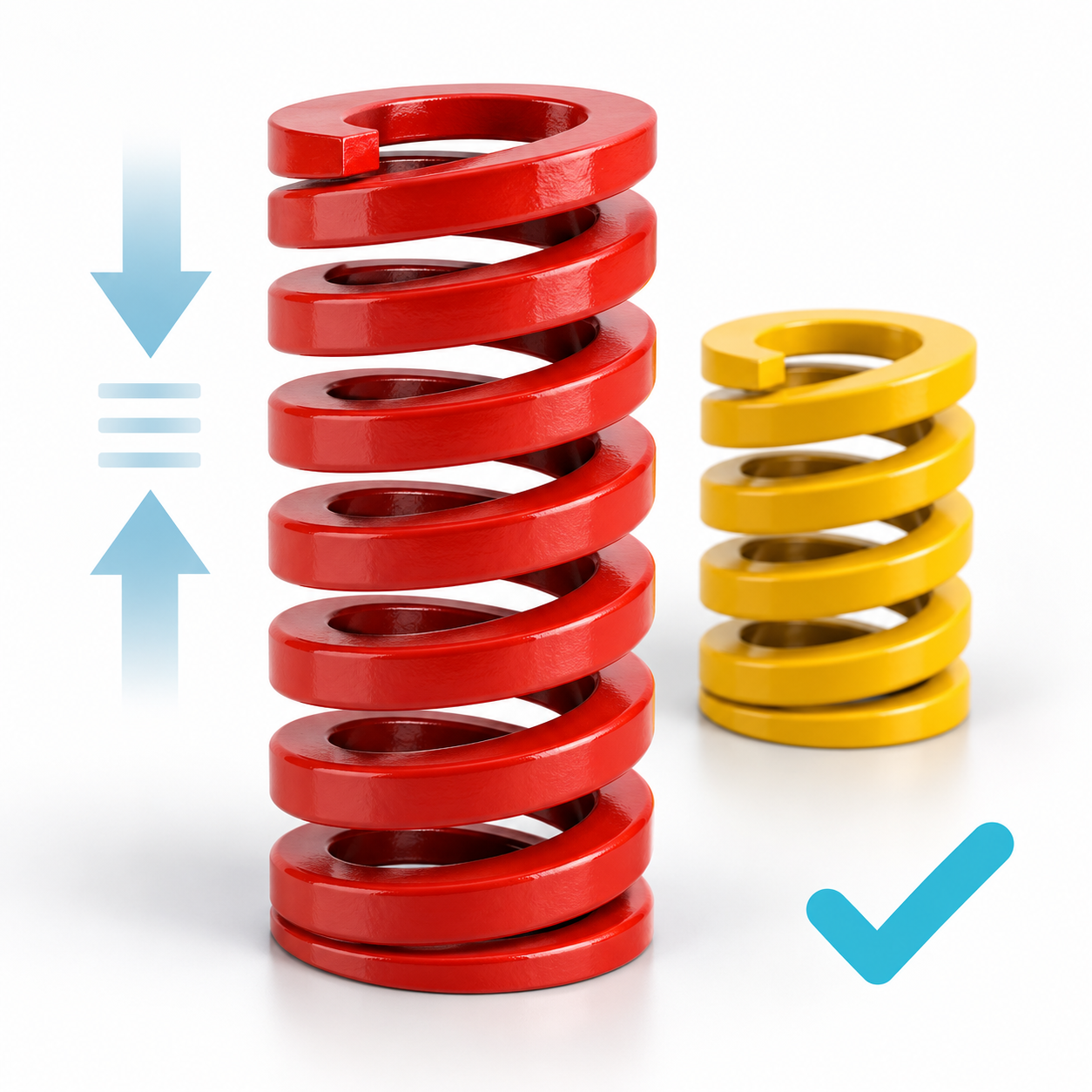 Select a die spring ›
Find suitable die springs and check the permissible travel under dynamic and static loads.
Select a die spring ›
Find suitable die springs and check the permissible travel under dynamic and static loads.
Die Springs for High Forces in Limited Installation Space
Die springs are heavy-duty compression springs designed for applications requiring high forces, short spring travel and compact installation dimensions. Typical applications include stamping and forming tools, pressure plates, strippers, ejectors, fixtures, moulds and general toolmaking.
Febrotec supplies die springs to DIN ISO 10243 as well as various Raymond® series. Use the product table to select suitable springs by hole diameter, rod diameter, free length, spring rate, spring travel, spring force, series and colour.
How to Select the Right Die Spring
Proceed in the following order:
-
Determine the installation space: Define the available hole diameter Dh, rod diameter Dd and free length L0.
-
Determine the required spring travel: Take both the preload and the spring travel during the working stroke into account.
-
Determine the required spring force: The spring force can be calculated approximately from the spring rate c and the total spring travel s:
F = c × s -
Consider the operating conditions: For applications with regular movement, use the dynamic values s1 and F1. The static values sn and Fn apply to static loads or applications that are only operated occasionally.
-
Select the appropriate series and load class: Do not select a spring based on colour alone. Always compare the installation dimensions, spring travel and spring force.
Meaning of the Technical Data
| Symbol | Meaning |
|---|---|
| Dh | Required hole or sleeve diameter |
| Dd | Corresponding rod or guide diameter |
| L0 | Free, unloaded spring length |
| c | Spring rate in N/mm |
| s1 | Recommended dynamic spring travel |
| F1 | Spring force at dynamic spring travel s1 |
| sn | Static spring travel |
| Fn | Spring force at static spring travel sn |
The technical limits specified for each individual product are decisive for the final spring selection.
Die Spring Colour Codes
The colour identifies the load class within a specific product series. However, the colour codes used for Raymond® and DIN ISO 10243 die springs are not directly interchangeable.
| Load class | Raymond® 0ST series | DIN ISO 10243 |
|---|---|---|
| Lightest or lower load class | Blue – medium load | Green – light load |
| Next load class | Red – medium-heavy load | Blue – medium load |
| High load | Bronze – heavy load | Red – heavy load |
| Very high load | Green – extra-heavy load | Yellow – extra-heavy load |
Always select the required product series first and then compare the spring forces, permissible spring travel and installation dimensions.
Recommendations for a Long Service Life
The service life of a die spring depends mainly on spring travel, operating speed, guidance, installation conditions and temperature.
For reliable operation, we recommend:
-
using several springs with a lower individual deflection instead of a small number of springs operating close to their load limit,
-
guiding long die springs with a rod, a hole or both,
-
ensuring that the supporting surfaces are flat and parallel,
-
avoiding compression to solid length,
-
not mixing springs of different series, lengths or load classes within the same tool,
-
replacing all springs subjected to the same load at the same time.
Material and Operating Temperature
Raymond® die springs are manufactured from high-strength chromium alloy steels and are designed for dynamic applications involving high loads.
At elevated temperatures, spring force and service life may be reduced. Always observe the maximum operating temperature, permissible spring travel and other technical limits specified for the individual product.
Frequently Asked Questions About Die Springs
What is the difference between a die spring and a standard compression spring?
Die springs are designed for particularly high forces and compact installation spaces. Their special wire cross-section provides high load capacity with comparatively short spring travel.
Can I select a die spring based on its colour alone?
No. The colour only identifies the load class within the respective product series. Raymond® and DIN ISO 10243 springs use different colour systems. Installation dimensions, spring rate, spring travel and spring force must also be compared.
How do I calculate the required number of die springs?
Divide the required total force by the force generated by one spring at the intended working stroke. Round the result up to a suitable number of springs and distribute them evenly throughout the tool.
What is the difference between dynamic and static spring travel?
Dynamic spring travel applies to springs that are compressed repeatedly during operation. Static spring travel applies to springs that remain under load or are only operated occasionally. For frequently cycling applications, the dynamic limits should be used.
Why should all die springs in a tool be replaced together?
Springs operating in the same tool are normally subjected to similar load cycles. Replacing only one spring can result in uneven force distribution because the remaining springs may already have experienced fatigue or permanent settling.